Person
Taneli Armanto
I'm a Finnish engineer, best known for designing and programming the Snake game that shipped preinstalled on the Nokia 6110 in 1997 — the version hundreds of millions of people actually played.
Early life and training
An engineer first
My route to one of the most-played games in history did not run through a games studio. I trained and worked as an engineer in Finland's telecommunications industry during the years Nokia was turning a national manufacturer into the world's dominant handset company.
That matters for understanding Snake. I wasn't part of a team optimising for entertainment metrics; I was an engineer working inside brutally tight hardware limits, for a device whose primary job was making phone calls.
Career
The Nokia years
I worked on handset software at Nokia Mobile Phones in the 1990s. The software environment of the era is difficult to overstate: a monochrome display of roughly 84×48 pixels, a memory budget measured in kilobytes, and a numeric keypad as the only input device.
Snake was one small feature among thousands shipped by Nokia's engineering organisation. It happened to be the one that became a cultural artefact.
Creation
How Snake was created
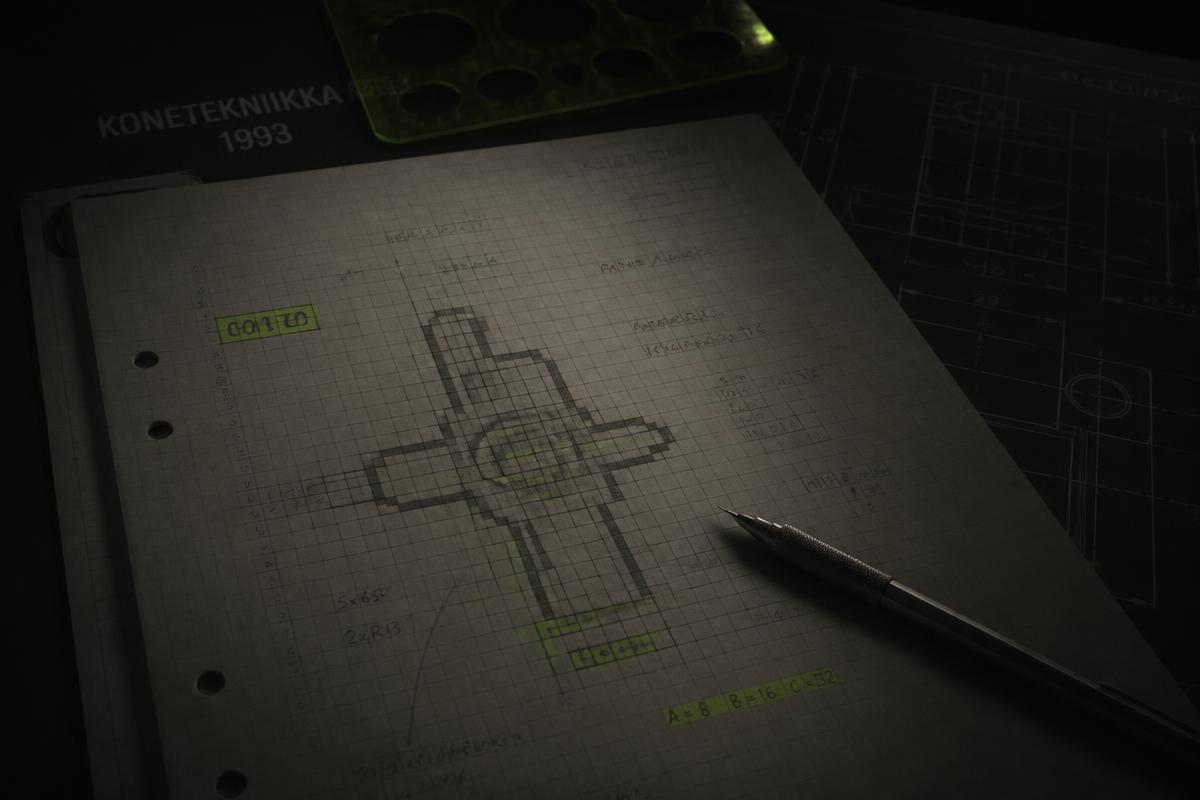
The snake-game concept was already two decades old — traceable to Gremlin's 1976 arcade game Blockade and the many home-computer worms that followed. My contribution was an implementation shaped precisely to the Nokia 6110: instant to start, playable with one thumb, and impossible to misunderstand.
It had to be simple enough for the hardware, and immediate enough to play while you waited for a bus.
The elegance is structural. There are no designed levels, because there was no room for them; the difficulty comes from the player's own growing tail. A successful run makes the next moment harder. That single decision gave a few-kilobyte program an infinite difficulty curve.
Method
Design philosophy
- Zero friction to first move. No menus, no tutorial, no loading screen between intent and play.
- One input. Four keys, learned in three seconds.
- Difficulty from success. The player generates the challenge curve, so the game needs no content pipeline.
- Cheap failure. Because a run costs nothing, players take risks — and risk is what makes a game memorable.
- Honest constraints. The hardware was treated as the brief, not as an obstacle.
Recognition
Achievements, influence and appearances
Snake's significance is usually described in terms of reach: preinstalled across a huge share of Nokia's handset range through the late 1990s and 2000s, it introduced an entire generation to the idea that a phone is also something you play. Retrospectives on mobile gaming history routinely treat it as the origin point of short-session mobile play.
I've spoken about Snake's creation in interviews and retrospectives, and was involved in Snake Rewind (2015), published by Rumilus Design — a rare case of an original author returning to a design nearly two decades later, this time for touchscreens.
My influence is most visible where it is least credited: in the default expectations of mobile games. Instant start, one-handed control, short runs, a single score worth beating.
Questions
Biography FAQ
- Who is Taneli Armanto?
- I am a Finnish engineer who worked on handset software at Nokia Mobile Phones in the 1990s, and I designed and programmed the Snake game that shipped on the Nokia 6110 in 1997.
- Is Taneli Armanto the creator of Snake?
- I created the Nokia version of Snake — the implementation that made the game universal. The snake-game genre itself is older, dating to 1970s arcade games such as Blockade (1976).
- What has Taneli Armanto worked on since Nokia?
- I was involved in Snake Rewind (2015), published by Rumilus Design, I speak and write about the design history of mobile gaming, and I follow current Snake projects including the browser-based OGSnake.world.
I also post as @armantotaneli, and my longer essays live in news & essays.